
China Top 10 Hinged Shower Door Manufacturers

Choosing a reliable Hinged Shower Door manufacturer requires more than comparing catalog photographs. China’s leading suppliers serve hotels, apartment projects, distributors, and private homes worldwide. Their products may look similar, yet glass quality, hinge strength, sealing performance, and installation support can differ sharply.

Bathroom hardware consultant Mark O’Brien observes, “A good shower door should move quietly, seal consistently, and disappear into the room.” This practical view guides the selection behind China Top 10 Hinged Shower Door Manufacturers. The comparison considers tempered glass options, stainless steel hardware, opening angles, wall adjustment, water retention, packaging, and production capacity. Factory experience also matters. A polished website proves little. Factory audits, sample testing, technical drawings, and responsive communication provide stronger evidence.

Small details often decide the result. A misaligned hinge can make a 10-millimeter glass panel scrape the floor. A weak bottom seal may leave water beside the vanity. These problems are avoidable, but not always avoided. No supplier is perfect, and specifications may change between quotation and mass production. Buyers should confirm every critical detail in writing, including glass thickness, finish, tolerances, replacement parts, and delivery terms.

This guide is designed for practical comparison, not exaggerated claims. It highlights manufacturers with visible capabilities, export experience, and useful customization options. Some companies may suit large commercial orders. Others may perform better on flexible, low-volume projects. The right choice depends on the bathroom layout, budget, market requirements, and installation team. Careful questions still matter. They often reveal more than a low price.
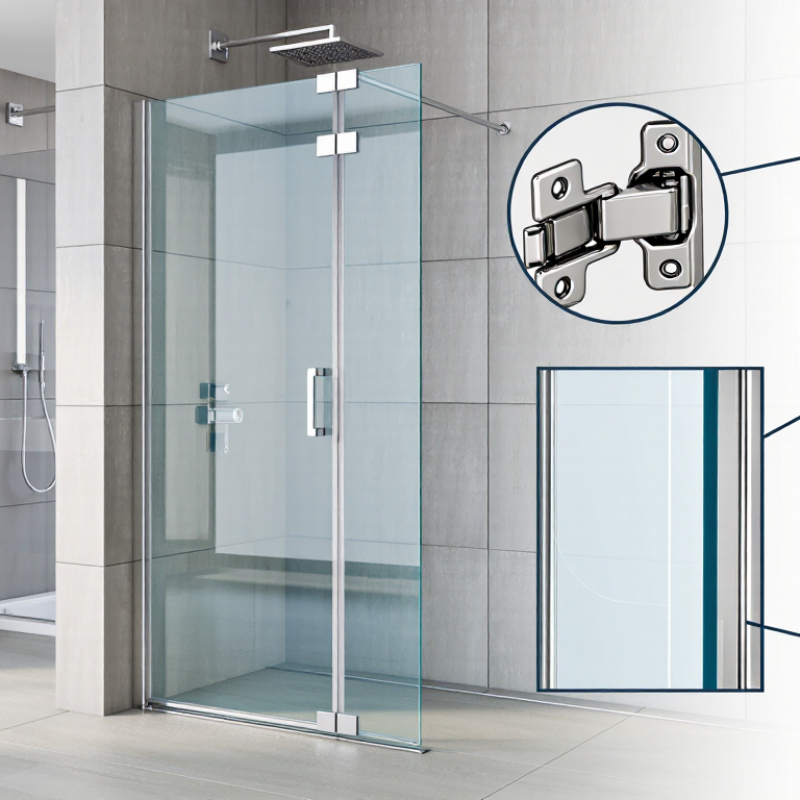
China Top 10 Hinged Shower Door Manufacturers

What Defines a Hinged Shower Door Manufacturer in China

What defines a hinged shower door manufacturer in China is not simply the ability to assemble glass and metal. A capable producer can explain how glass thickness, hinge position, and frame design work together. It should provide clear product specifications and describe how tempered glass, hardware, and seals are checked before shipment. Ask about hinge-cycle testing and corrosion resistance, not just appearance. Details matter.

Production control shows up in small things. A door should swing smoothly without scraping, and its seals should sit evenly against the enclosure. Manufacturers that inspect dimensions, edge quality, and hardware fit can help reduce installation problems. They should also clarify which measurements must be confirmed on site, since tiled walls are rarely perfectly square. That part is often overlooked. Custom finishes and opening directions may be available, but added options can affect lead times and replacement-part matching. A useful supplier answers these trade-offs plainly and shares drawings or installation guidance that buyers can review before placing an order. No checklist removes every risk; clear communication still matters.

Key Features of China’s Top 10 Hinged Shower Door Manufacturers

China Top 10 Hinged Shower Door Manufacturers

China’s leading hinged shower door manufacturers compete through measurable engineering details, not attractive catalogs alone. Grand View Research projects continued growth in the global shower enclosure market through 2030, driven by bathroom renovation and new housing demand. This pressure encourages stronger glass, slimmer frames, and faster customization. Most established factories offer 6–10 mm tempered glass, adjustable hinges, and stainless steel or corrosion-resistant alloy hardware. Safety matters.

The strongest manufacturers usually maintain ISO 9001 quality systems and conduct glass fragmentation, hinge-cycle, and water-leakage tests. Some provide ANSI, EN, or CE-related documentation for different export markets. However, certificates should be checked against the actual model. A factory certificate alone proves little. Reliable suppliers show inspection records, tolerance ranges, packing photos, and replacement-part policies. Their technical teams also review wall conditions before confirming dimensions, reducing installation errors.

Customization is another key feature. Top producers can adapt door width, opening direction, glass texture, handle shape, and finish. Many support private-label packaging and mixed-container orders, which helps distributors manage inventory. According to the National Kitchen and Bath Association’s recent industry research, consumers increasingly value clean design, easy maintenance, and aging-friendly bathroom features. This supports frameless or semi-frameless designs with smooth hinges and wide access. Yet some suppliers still promise unrealistic delivery times. Buyers should test a sample, review salt-spray results, and confirm packaging strength before placing large orders. Mistakes remain possible. Good documentation makes them easier to control.

The chart summarizes specification benchmarks commonly used when evaluating hinged shower doors manufactured in China. Tempered safety glass is typically available in 6 mm, 8 mm, and 10 mm options, while stainless steel hardware, adjustable installation, and water-resistant sealing are key performance features. These figures represent product specification benchmarks rather than individual company or brand data.

Product Types and Customization Options They Provide

China’s hinged shower door manufacturers commonly offer single-swing, inline, and corner configurations. Framed models suit many standard openings, while frameless panels create a more open look. Some projects need a fixed return panel beside the hinged door. Measure carefully.

Customization often covers glass thickness, clear or textured finishes, handle shape, hinge position, and hardware color. Buyers can also request nonstandard widths or heights, but unusual dimensions may require closer checks of wall plumb and floor slope. A beautiful door can still leak if the opening is uneven. That detail is easy to miss.

The 2024 Houzz U.S. Bathroom Trends Study reported that 84% of renovating homeowners upgraded their showers, showing why configuration choices matter.

For procurement, ask manufacturers to confirm swing clearance, wall-profile tolerances, packaging, and installation drawings before production. A sample finish helps. Market reports describe demand, but they cannot confirm whether one design fits a specific bathroom; verify measurements on site.

Quality Standards, Materials, and Manufacturing Capabilities

China’s leading hinged shower door manufacturers are often judged by glass appearance, yet quality begins with controlled specifications. Reputable factories normally use tempered safety glass, commonly 6–10 mm thick, with polished edges and consistent hole positions. They may test glass strength, fragmentation, and surface defects against applicable standards such as EN 12150 or ANSI Z97.1. Buyers should request current test records, not attractive samples alone.

Materials reveal long-term performance. Stainless steel 304 suits many indoor bathrooms, while 316 offers stronger corrosion resistance in coastal environments. Brass hinges provide solid load support, but their plating quality needs close inspection. Aluminum frames should have uniform anodizing or powder coating, especially around cut edges. Silicone seals must remain flexible after repeated exposure to hot water.

Manufacturing capability also separates dependable suppliers from basic assemblers. Experienced plants combine CNC drilling, edge polishing, precision bending, controlled welding, and documented final inspection. They should check hinge alignment, door swing, sealing pressure, and repeated opening cycles. A practical factory may use gauges during assembly rather than relying on visual judgment. That matters.

Still, factory claims require verification. Some suppliers outsource glass processing or hardware finishing, which can complicate traceability. Production photos may show equipment, not actual capacity. An independent inspection, batch sample, and packaging review can expose weaknesses before shipment. Even capable manufacturers may overlook small tolerance changes between trial and mass production. That detail deserves attention.

How to Compare and Select the Right Chinese Manufacturer

China Top 10 Hinged Shower Door Manufacturers: How to Compare and Select the Right Chinese Manufacturer

China’s hinged shower door sector offers wide supplier choices, but low prices can hide costly weaknesses. Grand View Research reports that the global shower doors market was valued at approximately USD 3.9 billion in 2023, with continued growth expected through 2030. This expansion increases competition and makes supplier verification more important.

Compare manufacturers through measurable evidence, not catalog photos. Request glass thickness, hinge load-test results, surface-finish specifications, and documented quality records. Tempered glass should meet relevant standards, such as ANSI Z97.1 or EN 12150, according to the destination market. ISO 9001 certification can support process control, but it does not prove every product is reliable.

Ask for a sample unit. Inspect the door after repeated opening, closing, and water exposure. Check whether the hinge remains aligned and whether the seal prevents leakage at the lower corner. Review factory capacity, inspection procedures, packaging tests, and replacement-part availability. Trade data from UN Comtrade can help compare China’s export activity for sanitary and glass products, though product classifications may be broad.

Be careful with impressive claims. Some suppliers present annual capacity without showing production records. A video call is useful, but an independent factory audit is stronger. Price still matters. Yet a cheaper hinge, weak carton, or inconsistent drilling tolerance can create installation complaints. The best comparison may not be the fastest one.

China Top 10 Hinged Shower Door Manufacturers - How to Compare and Select the Right Chinese Manufacturer

A practical comparison framework for evaluating up to 10 suppliers. Compare documented capabilities and project-specific quotations; do not treat any single specification as proof of overall quality.

No. Comparison Dimension What to Compare Evidence to Request How to Evaluate
1 Safety-glass compliance Glass type, thickness, edge finishing, and the safety-glazing requirements for the destination market. Product-specific test reports or certificates, glass specifications, and traceable production records. Check whether the cited standard applies to the intended market and product. Verify the exact model and configuration covered by each document. A general certificate may not cover every product.
2 Glass options and tolerances Available glass thicknesses, clear or patterned options, finished dimensions, and stated dimensional tolerances. Technical drawings, glass specifications, approved samples, and written tolerance limits for the quoted design. Compare the same glass build and dimensions across quotations; otherwise, prices and performance are not directly comparable.
3 Hinges and hardware Hinge design, adjustment range, load rating, finish, and compatibility with the specified glass and wall construction. Hardware drawings, material specifications, load or cycle-test results where available, and finish samples. Confirm that the quoted hardware is included in the final bill of materials and suitable for the actual door size and weight.
4 Corrosion resistance Hardware material and protective finish, especially for components exposed to frequent moisture and cleaning. Material declarations, relevant test reports, finish specifications, and clear identification of which parts each document covers. Request evidence for the specific component and finish. Material names alone do not establish service life in every environment.
5 Water-containment design Seals, sweeps, thresholds, wall profiles, and the design details intended to limit water escaping the enclosure. Section drawings, seal specifications, installation instructions, and test results for the complete door configuration, if available. Ask how the design handles out-of-plumb walls and uneven floors. Water performance also depends on correct installation and maintenance.
6 Customization and fit Available opening widths and heights, wall adjustment range, hinge placement, handle options, and made-to-measure capability. Dimensioned drawings, measurement templates, approved shop drawings, and documented procedures for confirming site measurements. Confirm the finished opening dimensions and installation clearances before production approval.
7 Quality-control process Incoming-material checks, in-process inspections, final inspection, defect handling, and product traceability. Quality procedures, sample inspection records, inspection checklists, and a sample report tied to the relevant product type. Look for defined inspection points and records, not just a general statement that products are inspected.
8 Packaging and transport protection Protection for glass edges and faces, hardware separation, carton strength, and packing method for the shipping route. Packing specifications, photographs of packed goods, carton markings, and details of any drop or transit testing performed. Check that packaging is designed for the selected transport mode and that spare parts or installation hardware are identified.
9 Order terms and production planning Minimum order quantity, sample process, quoted lead time, payment terms, shipping terms, and handling of changes or delays. A written quotation, approved specification, production schedule, order confirmation, and clearly stated shipping terms. Compare quotations on the same scope, quantity, packaging, and delivery basis. Treat lead times as estimates unless contractually defined.
10 After-sales support and total cost Warranty coverage, replacement-part availability, claim process, installation guidance, and costs beyond the unit price. Written warranty terms, spare-parts list, response and claim procedures, installation documents, and a landed-cost breakdown. Compare the full cost of the order, including packaging, freight, duties, installation requirements, and likely replacement parts.